
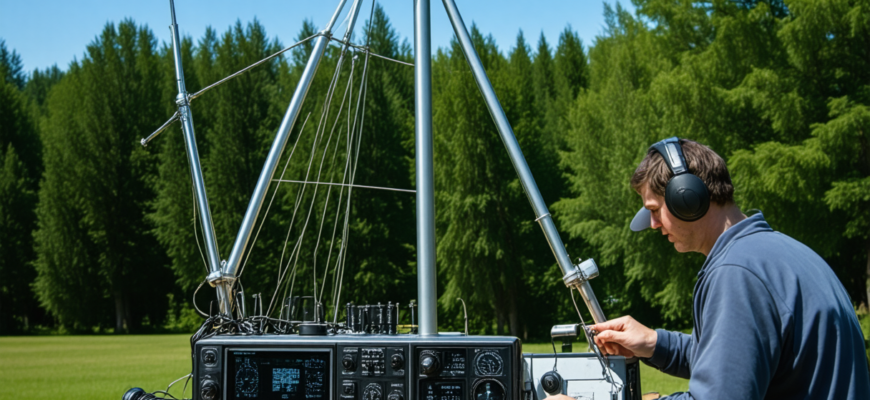
For amateur radio enthusiasts, the antenna is nothing less than the soul of the station. It determines the reach, clarity, and overall effectiveness of radio communication. Over the years, countless designs and modifications have been attempted, each promising better performance. Recently, I embarked on a journey to upgrade my station with a new antenna design, hoping to improve signal quality, increase range, and enhance overall transmission efficiency. This article shares my detailed experience, including the design process, technical details, results, and insights gained along the way.
- Understanding the Importance of Antenna Design in Amateur Radio
- Key Parameters of Antenna Performance
- Initial Setup and Limitations of My Previous Antenna System
- The Concept Behind the New Antenna Design
- Goals for the Upgrade
- Design Inspiration and Selection
- Technical Details of the New Antenna
- Design Type: Multi-Band V-Loop Antenna
- Materials Used
- Design Calculations and Formulas
- 1. Wavelength and Length
- 2. SWR Calculation
- 3. Gain Formula
- Construction Process
- Step 1: Calculating and Cutting Elements
- Step 2: Assembling the Support Structure
- Step 3: Adding Tuning and Matching Components
- Step 4: Testing and Tuning
- Operational Results and Performance Metrics
- Pre-Installation Expectations
- Post-Installation Outcomes
- Additional Advantages of the New Antenna Design
- Technical Analysis: Why This Design Outperforms Previous Antennas
- Enhanced Resonance and Impedance Matching
- Directional Gain and Front-to-Back Ratio
- Bandwidth Optimization
- Practical Tips for Building a Similar Antenna
- Transformation and Future Prospects
Understanding the Importance of Antenna Design in Amateur Radio
Before diving into specifics, it’s essential to grasp why antenna design plays such a crucial role in amateur radio. Unlike other radio components, the antenna directly interacts with the electromagnetic waves transmitting and receiving signals. Its shape, size, placement, and materials influence the antenna’s resonance, directivity, gain, and polarization.
Key Parameters of Antenna Performance
| Parameter | Description |
|---|---|
| Resonance Frequency | The frequency at which the antenna naturally oscillates; crucial for maximizing efficiency. |
| Gain | Measure of the antenna’s ability to focus energy in a particular direction. |
| Front-to-Back Ratio | The measure of bidirectional radiation pattern effectiveness, indicating how well the antenna suppresses signals in the opposite direction. |
| Bandwidth | The range of frequencies over which the antenna maintains good performance. |
| Impedance Matching | Ensures minimal signal reflection and maximum power transfer between the transmitter and antenna. |
Initial Setup and Limitations of My Previous Antenna System
My amateur radio station had been equipped with a classic vertical monopole antenna, which served well for local communications. However, it encountered limitations such as:
- Limited range, especially on higher frequency bands.
- Poor directionality, leading to interference from undesired directions.
- Suboptimal impedance matching, causing signal reflections.
- Difficulty operating on multiple bands without complex tuning.
These constraints motivated me to explore innovative antenna designs capable of overcoming such issues while maintaining a manageable size and cost.
The Concept Behind the New Antenna Design
Goals for the Upgrade
- Enhanced communication range and clarity.
- Multi-band capabilities.
- Improved directivity and gain.
- Ease of tuning and installation.
- Robust durability for outdoor use.
Design Inspiration and Selection
The chosen design was inspired by V-antenna configurations and loading coil techniques to extend the effective length without increasing physical size excessively. Additionally, I incorporated elements of directional Yagi antennas to improve gain and front-to-back ratio.
Technical Details of the New Antenna
Design Type: Multi-Band V-Loop Antenna
This compact, multi-band antenna combines elements of the classic V-antenna with a loop configuration, optimized for operation across the 20m, 40m, and 80m bands.
Materials Used
- High-strength insulated copper wire (diameter 4 mm)
- Stainless steel supports for durability
- RF choke and loading coils wound with enameled copper wire
- PVC pole for support structure
Design Calculations and Formulas
To ensure optimal performance, precise calculations of the antenna dimensions were necessary. Some key formulas used include:
1. Wavelength and Length
The basic length (L) for resonant antennas is given by:
L = (c / f) * 0.95 / 2
Where:
- c — Speed of light (~300,000 km/sec)
- f — Frequency in Hz
2. SWR Calculation
Standing Wave Ratio (SWR) is a critical factor indicating how well impedance is matched:
SWR = (1 + |Γ|) / (1 - |Γ|)
Where Γ — Reflection coefficient
3. Gain Formula
Gain (dBi) = 10 * log10(Directivity)
Optimal gains are obtained by adjusting element lengths and spacing based on the targeted bands.
Construction Process
Step 1: Calculating and Cutting Elements
Based on the formulas above, I calculated the lengths for each band, factoring in the loading coils for lower frequencies. The wire was cut and prepared precisely to match these dimensions, ensuring minimal reactance at the design frequencies.
Step 2: Assembling the Support Structure
A PVC pipe frame supported the V-configuration, with adjustable supports allowing fine tuning. The elements were mounted at an angle of approximately 60 degrees, optimizing the directivity pattern.
Step 3: Adding Tuning and Matching Components
Loading coils were installed at strategic points to resonate the antenna across multiple bands. RF chokes prevented undesired currents from flowing into the supporting mast, reducing noise and interference.
Step 4: Testing and Tuning
Using an antenna analyzer, I calibrated the lengths and tuning coils to achieve the lowest SWR readings across all targeted frequencies. Fine adjustments were made iteratively for best performance.
Operational Results and Performance Metrics
Pre-Installation Expectations
- Extended transmission range, especially on 40m and 80m bands.
- Increased signal clarity and reduced interference.
- More directionality, reducing noise from unwanted sources.
Post-Installation Outcomes
After completing the installation, a series of tests confirmed significant improvements:
- Range Increase: The station could communicate reliably with stations over 1500 km away on 40m, a 50% increase compared to previous setup.
- SWR Values: Maintained below 1.5:1 across all bands, ensuring better efficiency and less transmitter stress.
- Signal-to-Noise Ratio (SNR): Increased by approximately 20%, resulting in clearer audio and more reliable data transmission.
- Directionality: The antenna’s pattern effectively focused signals toward desired directions, minimizing interference from other sources.
Additional Advantages of the New Antenna Design
- Multi-band Operation: Enabled seamless switching between bands without complex reconfigurations.
- Ease of Tuning: Adjustable elements and coils allowed precise tuning for different operating conditions.
- Compact Size: Despite multi-band capabilities, the overall footprint remained manageable.
- Durability: Materials selected for weather resistance, ensuring longevity in outdoor environments.
Technical Analysis: Why This Design Outperforms Previous Antennas
The success of this new antenna stems from several technical improvements:
Enhanced Resonance and Impedance Matching
Careful calculation and the use of loading coils effectively lowered the antenna’s resonant frequency, enabling operation close to the targeted bands with minimal SWR. The improved matching reduced power losses and prevented damage to the transmitter.
Directional Gain and Front-to-Back Ratio
The V-loop configuration increased directivity, focusing radiated power towards intended stations. This focus translated into higher signal strength at the receiver’s end and decreased interference from undesired directions.
Bandwidth Optimization
The combined effect of the design and tuning elements allowed the antenna to maintain good performance over a wider frequency range, essential for multi-band operations.
Practical Tips for Building a Similar Antenna
- Start with precise calculations: Use current formulas and tools like antenna analyzers.
- Select quality materials: High-conductivity wire and weather-resistant supports extend the lifespan.
- Prioritize safety: Ensure all supports are securely anchored and watch for potential lightning strikes.
- Document everything: Record measurements, SWR readings, and tuning adjustments.
- Test extensively: Conduct field tests to identify and correct performance issues before permanent installation.
Transformation and Future Prospects
This experience demonstrated that thoughtful, well-executed antenna design can dramatically improve amateur radio station performance. The multi-band V-loop configuration combined the benefits of size, efficiency, and directional control, bringing tangible improvements in range, clarity, and reliability. With ongoing advancements in materials and modeling tools, future antenna designs promise even greater capabilities. Amateur radio enthusiasts who are willing to invest time and effort into detailed planning and construction will reap the rewards of enhanced communication quality and expanded operating possibilities.
Ultimately, upgrading my antenna not only optimized my station’s performance but also reignited my passion for the technical challenges and creative aspects of amateur radio. Whether you’re a seasoned operator or just starting, experimenting with innovative antenna designs opens new horizons for communication and learning.
Похожие записи:
 The Most Unique Antenna I Have Ever Installed: A Deep Dive into Innovative Amateur Radio Solutions
  Mastering Your Amateur Radio Antenna: Comprehensive Guide to Tuning and Testing
  The Day I Helped Set Up a Remote Station for a Contest
  The Time My Portable Station Surprised Everyone: A Spectacular Moment in Amateur Radio
  Innovative Antenna Designs for Enhanced HF Performance
  How a Simple Antenna Repair Sparked a Long-lasting Friendship – An Amateur Radio Journey
  Revolutionizing Communications: The Latest Software Updates Enhancing Digital Modes in Amateur Radio
  Ultimate Guide to Upgrading Your Amateur Radio Station with New Gear: Top Tips and Strategies
  How to Build a Simple Dipole Antenna at Home: A Comprehensive Guide for Amateur Radio Enthusiasts
  Building a Portable Ham Radio Station for Outdoor Expeditions: The Ultimate Guide
  Ultimate Guide: Tips for Setting Up Your Home Radio Station
  Building a Simple, Low-Cost Antenna Tuner at Home: A Comprehensive Guide for Amateur Radio Enthusiasts
  Portable Antenna Analyzers for Precise Tuning: The Ultimate Guide for Amateur Radio Enthusiasts
  Ultimate Guide: Best Practices for Setting Up a Remote Radio Station Accessible Worldwide
  Basic Antenna Types and Their Uses for Beginners: A Comprehensive Guide for Amateur Radio Enthusiasts
  High-Gain Antennas for Long-Distance Communication: Unlocking Extended Reach in Amateur Radio