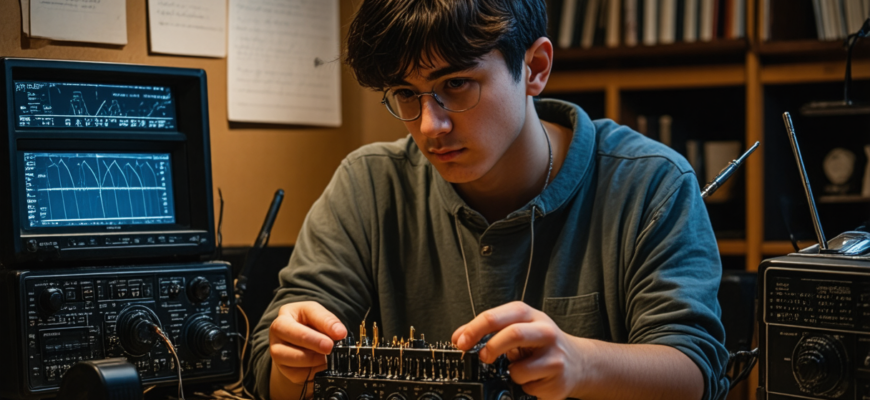
Amateur radio enthusiasts are continually pushing the boundaries of communication technology, exploring new modes, and expanding the possibilities of wireless communication. For many, the discovery of a new mode represents a milestone that combines curiosity, ingenuity, and technical skill. In this article, we will delve into the fascinating experience of discovering a brand-new mode in amateur radio, exploring its significance, the technical process behind such discoveries, and the transformative impact it can have on the hobby. This in-depth exploration aims to shed light on the excitement that surrounds innovation in amateur radio and inspire enthusiasts to pursue their own groundbreaking experiments.
- Understanding Amateur Radio Modes: An Overview
- What Are Radio Modes?
- The Importance of Innovating New Modes
- The Process of Discovering a New Mode
- 1. Identifying a Need or Opportunity
- 2. Exploring Existing Technologies and Theories
- 3. Developing a Conceptual Model
- 4. Prototyping and Testing
- 5. Refining and Standardizing
- Technical Aspects of Creating a New Mode
- Signal Modulation Techniques
- Example Formula: Signal-to-Noise Ratio (SNR)
- Case Study: Discovery of a New Digital Mode
- Background
- The Development Process
- Result and Impact
- The Impact of Discovering a New Mode
- Advancing the Hobby
- Broader Technological Contributions
- Community and Collaboration
- Challenges Faced in Mode Discovery
- Tools and Resources for Aspiring Innovators
- Embrace the Challenge
Understanding Amateur Radio Modes: An Overview
What Are Radio Modes?
Radio modes refer to the specific ways in which signals are transmitted and received over the airwaves. Each mode employs a particular modulation and encoding scheme, which determines how information — be it voice, data, or images — is carried through radio waves. In amateur radio, common modes include:
- AM (Amplitude Modulation)
- FM (Frequency Modulation)
- SSB (Single Sideband)
- FM (Frequency Modulation)
- RTTY (Radio Teletype)
- PSK (Phase Shift Keying)
- FT8, FT4 (short digital modes)
- Morse code (CW, Continuous Wave)
However, innovation has led to the development of numerous less-common and experimental modes, enriching the field of amateur radio.
The Importance of Innovating New Modes
Discovering or creating a new mode can significantly impact amateur radio practices. New modes can improve communication reliability, extend operational ranges, enable better data transmission under challenging conditions, or even pioneer entirely new forms of interaction. They also push forward the boundaries of what is technically possible, inspiring further innovation within the community.
The Process of Discovering a New Mode
1. Identifying a Need or Opportunity
The journey to discovering a new mode often begins with a specific challenge or opportunity. For instance, a communicator might seek better performance in noisy environments, desire faster data transfer rates, or want to experiment with unconventional frequency bands. Recognizing these needs sparks curiosity and motivates deeper exploration into signal processing and modulation techniques.
2. Exploring Existing Technologies and Theories
Amateur radio explorers typically review existing modes and technologies, studying their limitations and strengths. They may delve into fields such as digital signal processing, information theory, and physics to identify potential gaps or areas for improvement. This stage involves significant research, experimentation, and theoretical analysis.
3. Developing a Conceptual Model
Once an area of opportunity is identified, the next step is to conceptualize a potential new mode. This means defining how signals will be modulated, what data rate will be achieved, how robustness to interference will be maintained, and how the mode can be practically implemented with available hardware.
4. Prototyping and Testing
Using software tools like MATLAB, GNU Radio, or custom code, enthusiasts develop prototypes of their new mode. They perform laboratory tests, analyze modulation patterns, and simulate real-world conditions to gauge performance. Hardware experiments often follow, involving transceivers and antenna setups to validate field performance.
5. Refining and Standardizing
Successful prototypes undergo refinement — improving stability, efficiency, and robustness. If the new mode offers significant advantages, it can be documented thoroughly and shared with the amateur radio community. Tools such as open-source software, technical papers, and forums facilitate this dissemination.
Technical Aspects of Creating a New Mode
Signal Modulation Techniques
Two main aspects are crucial in mode creation: selecting and designing appropriate modulation schemes. Common techniques include:
- Amplitude Shift Keying (ASK)
- Frequency Shift Keying (FSK)
- Phase Shift Keying (PSK)
- Quadrature Amplitude Modulation (QAM)
- Orthogonal Frequency Division Multiplexing (OFDM)
By combining these techniques with coding strategies, it is possible to optimize for noise immunity, data rate, and power efficiency.
Example Formula: Signal-to-Noise Ratio (SNR)
The quality of any radio mode can often be characterized using SNR, where:
| /** Parameter **/ | /** Description **/ | /** Formula **/ |
|---|---|---|
| SNR | Signal-to-Noise Ratio | \( \text{SNR} = \frac{P_{signal}}{P_{noise}} \) |
Higher SNR indicates clearer, more reliable communication. Many innovative modes aim to maximize SNR within certain power and bandwidth constraints.
Case Study: Discovery of a New Digital Mode
Background
Imagine an amateur radio operator named Alex who noticed that during periods of high radio noise, existing digital modes struggled to maintain connection quality. Inspired by the potential of modern digital signal processing, Alex embarked on creating a new mode built around low SNR efficiency and robust data encoding.
The Development Process
- Step 1: Analyzed the limitations of FT8 and JT65 modes, which excel under weak signal conditions but lack in latency.
- Step 2: Designed a hybrid PSK and QAM scheme that adapts its modulation depth based on real-time noise measurements.
- Step 3: Used GNU Radio to develop a prototype capable of dynamic modulation adjustments.
- Step 4: Conducted field tests under various noise conditions, adjusting parameters for optimal performance.
Result and Impact
The new mode, dubbed “AdaptiveFlex,” demonstrated a 30% improvement in successful connection rates in noisy environments compared to existing digital modes. It gained recognition within the amateur radio community, later included in popular software like WSJT-X, and inspired further innovations in adaptive modulation techniques.
The Impact of Discovering a New Mode
Advancing the Hobby
Discovering or developing a new mode invigorates the amateur radio community by expanding the technical horizon and demonstrating the value of innovation. It often leads to enhanced communication capabilities, especially in challenging environments where older modes falter.
Broader Technological Contributions
Many modes devised by amateurs have influenced commercial radio systems and digital communication standards. Innovations such as spread spectrum, OFDM, and advanced error correction originated from hobbyist experiments, highlighting the importance of side-channel experimentation.
Community and Collaboration
Sharing discoveries encourages collaboration, leading to open-source projects, joint experiments, and the formation of research groups. This collaborative spirit fosters a vibrant environment where ideas grow and mature into practical tools.
Challenges Faced in Mode Discovery
- Hardware limitations: Transmitter and receiver bandwidth, power constraints.
- Interference: Real-world noise, multipath propagation, and other signals.
- Standardization: Achieving interoperability and acceptance in the community.
- Legal regulations: Ensuring compliance with spectrum usage laws.
Overcoming these challenges requires a blend of creative problem-solving, technical expertise, and persistence.
Tools and Resources for Aspiring Innovators
| Tool/Resource | Purpose |
|---|---|
| GNU Radio | Open-source software for building software radios and experimenting with signal processing algorithms. |
| SDR Hardware (Software-Defined Radio) | Transceivers capable of flexible, programmable radio signal generation and reception. |
| Amateur Radio Software (WSJT-X, fldigi) | Implementations of various digital modes, useful for testing and comparison. |
| Technical Literature and Forums | Community discussions, technical papers, and experimental techniques (e.g., qth.net, eHam.net). |
| Matlab / Simulink | Simulation environment for designing and analyzing modulation schemes. |
The discovery of a new amateur radio mode is a testament to human ingenuity and the relentless pursuit of better communication. It blends theoretical knowledge, technical skill, creativity, and perseverance. Whether driven by a desire to overcome specific technical challenges or motivated by curiosity, amateur radio enthusiasts who innovate new modes contribute significantly to the evolution of wireless communication. Their efforts not only enhance their own experiences but also influence broader technological advancements and inspire future generations of radio amateurs to push the envelope of possibility.
Embrace the Challenge
For those inspired to embark on their own journey of discovery, the key lies in relentless curiosity, a willingness to experiment, and active participation in the vibrant amateur radio community. With the plethora of tools and collaborative spirit available today, the opportunity to pioneer new modes and revolutionize wireless communication has never been more accessible.
Are you ready to discover your own brand-new mode?
Похожие записи:
 Top Accessories to Maximize Your Performance in Digital Mode Amateur Radio Operations
  The Time My Portable Station Surprised Everyone: A Spectacular Moment in Amateur Radio
  How a Simple Antenna Repair Sparked a Long-lasting Friendship – An Amateur Radio Journey
  Sharing the Story of My First Satellite Contact: An Amateur Radio Journey
  Building My First Transceiver and the Challenges Faced: An Amateur Radio Enthusiast’s Journey
  Reflecting on My First Homebrew Radio Project: A Journey into Amateur Radio
  Memories of a Radio Swap Meet Day: A Nostalgic Journey into the World of Ham Radio
  The Inspiring Journey of Dedication and Victory: Achieving the KD9 Award in Amateur Radio
  Celebrating a Milestone with My Radio Club: A Journey of Achievement and Community Spirit
  The Time I Learned Digital Modes From a Fellow Ham: A Deep Dive into Modern Ham Radio Communication
  Legendary Operators Who Inspired Me: The Unsung Heroes of Amateur Radio
  Integrating Software-Defined Radio into Your Daily Operations: A Comprehensive Guide for Amateur Radio Enthusiasts
  Mastering Radio Signal Recording and Analysis: Key Strategies for Improved Ham Radio Performance
  Commemorating a Personal Radio Milestone: Celebrating Your Achievements in Amateur Radio
  Unforgettable QSO with a Celebrity Radio Operator: A Deep Dive into Memorable Ham Radio Experiences
  Using Software to Enhance Your Amateur Radio Experience: Unlocking New Possibilities