
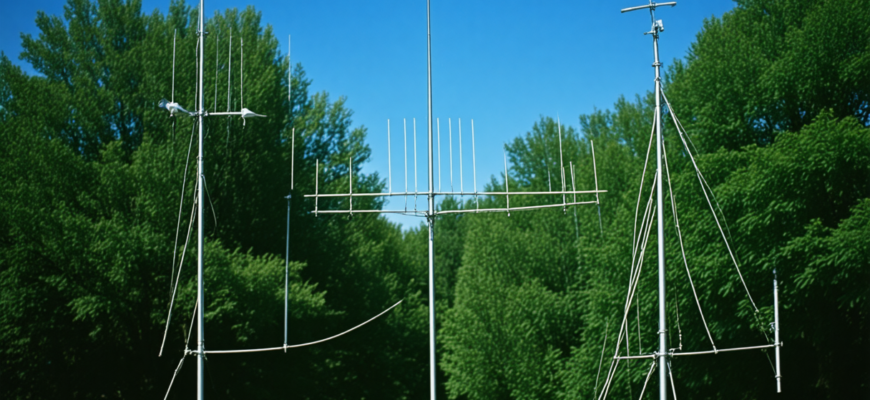
For newcomers to amateur radio, understanding different antenna types is fundamental to successfully setting up and operating a station. Antennas are the bridge between your radio and the world, converting electrical signals into radio waves and vice versa. With a multitude of antenna designs available, selecting the right type can seem overwhelming. This guide aims to demystify the most common antenna types, explore their applications, advantages, and limitations, providing a solid foundation for amateur radio enthusiasts starting their journey in the fascinating world of radio communication.
- Understanding the Basics of Antennas
- Common Types of Antennas for Beginners
- 1. Vertical Resonant Antennas
- Description
- Uses
- Advantages
- Limitations
- 2. Dipole Antennas
- Description
- Uses
- Advantages
- Limitations
- 3. Vertical Monopole with Radials
- Description
- Uses
- Advantages
- Limitations
- 4. Ground-Plane Antennas
- Description
- Uses
- Advantages
- Limitations
- 5. Dipole Variants: Inverted-Vee and End-Fed
- Inverted-Vee Dipole
- End-Fed Antennas
- Uses
- Advantages
- Limitations
- Directional Versus Omnidirectional Antennas
- Omnidirectional Antennas
- Directional Antennas
- Choosing the Right Antenna for Beginners
- Practical Tips for Beginners
- Mathematical Foundations and Formulas
- Wavelength and Antenna Length
- Quarter-Wave Vertical Antenna Length
- Example Calculation
Understanding the Basics of Antennas
Before diving into specific antenna types, it’s important to grasp some fundamental concepts:
- Resonance: An antenna is resonant when its physical length corresponds to a specific wavelength, allowing it to efficiently radiate or receive signals at that frequency.
- Impedance: To maximize power transfer, an antenna’s impedance must match that of the transmitter—commonly 50 ohms in amateur radio.
- Radiation Pattern: The spatial distribution of radiated energy characterized by the antenna’s shape and orientation. Patterns can be omnidirectional, directional, or bidirectional.
- Gain: A measure of how well an antenna directs radio energy in a particular direction compared to a reference (typically an isotropic source).
Common Types of Antennas for Beginners
1. Vertical Resonant Antennas
Description
Vertical antennas are one of the simplest and most popular types among beginners. They are characterized by a single vertical element, often grounded or elevated with radials. The quarter-wave vertical is the most common example.
Uses
- 2-meter and 70-centimeter bands for local communication
- HF bands for long-distance QSLs with appropriate radials
Advantages
- Compact size suitable for limited space
- Good ground-wave and sky-wave propagation for local and regional contacts
- Relatively easy to install
Limitations
- Lower gain compared to directional antennas
- Requires radials for optimal performance
2. Dipole Antennas
Description
The dipole is perhaps the most fundamental antenna, consisting of two equal-length conductive elements arranged in a straight line. For a basic horizontal dipole, the total length is approximately half the wavelength of the operating frequency.
Uses
- HF, VHF, and UHF bands for general-purpose listening and transmitting
- Outdoor and indoor applications
Advantages
- Simple and inexpensive to implement
- Good bandwidth and efficiency at resonance
- Easy to modify for different frequencies
Limitations
- Requires space for proper deployment
- Orientation affects radiation pattern
3. Vertical Monopole with Radials
Description
This is a variation of the vertical antenna, augmented with radials to improve ground conductivity and radiation efficiency. Typical for base stations and portable applications.
Uses
- HF operations with improved efficiency
- Amateur base station antenna
Advantages
- Enhanced performance over simple verticals
- Compact and easy to tune
Limitations
- Requires radials that may need extended outdoor space
4. Ground-Plane Antennas
Description
Ground-plane antennas are variants of vertical antennas that use several radials as a simulated ground plane. They often feature a central radiator with four or more radials extending horizontally or downward.
Uses
- VHF/UHF mobile and base stations
- Short-range communication and repeater links
Advantages
- Simple construction
- Good performance in mobile environments
Limitations
- Radials must be properly tuned and positioned
5. Dipole Variants: Inverted-Vee and End-Fed
Inverted-Vee Dipole
A dipole shaped with a central support point, creating a V shape. It is space-efficient and easier to install at height.
End-Fed Antennas
Features a long wire fed from one end, often used for portable operations and accessing multiple bands.
Uses
- Portable and field operation
- Multiband capabilities with suitable transformers or matching units
Advantages
- Requires less support height
- Flexible installation options
Limitations
- Matching can be tricky; may need antenna tuners
Directional Versus Omnidirectional Antennas
Omnidirectional Antennas
These antennas radiate radio signals equally in all horizontal directions. They are ideal for local communication, providing a broad coverage area without needing precise orientation.
Directional Antennas
Designed to focus energy in specific directions, resulting in higher gain and longer reach in chosen directions. These are useful for point-to-point links, long-distance communication, and minimizing interference.
Choosing the Right Antenna for Beginners
| Factor | Recommended Antenna Types | |
|---|---|---|
| Available Space | Vertical monopoles, dipoles, end-fed antennas | |
| Frequency Band | Shortwave (HF): Dipoles, inverted-V | VHF/UHF: Ground-plane, vertical monopoles |
| Ease of Setup | Vertical antennas, rubber ducky antennas for handhelds | |
| Long-Distance Communication | Directional Yagi antennas, beam antennas | |
| Portability | End-fed antennas, wire antennas, portable verticals |
Practical Tips for Beginners
- Start with simple antennas: Begin with dipoles or vertical monopoles to understand basic operation and measurement.
- Use antenna tuners: Proper matching ensures maximum efficiency and prevents damage to your transmitter.
- Experiment with orientation: Changing antenna direction or height can dramatically influence signal quality.
- Mind the environment: Metal objects, trees, and buildings alter radiation patterns, so choose your location wisely.
- Maintain your antenna: Regular checks and adjustments keep your system operating at peak performance。
Mathematical Foundations and Formulas
Wavelength and Antenna Length
The fundamental relation for antenna sizing is based on wavelength, λ:
λ = c / f
- c: Speed of light (approximately 300,000 km/s)
- f: frequency in Hz
Quarter-Wave Vertical Antenna Length
Height (h) of a quarter-wave vertical antenna:
h = λ / 4
Example Calculation
For a 20-meter band (around 14 MHz):
- λ = 300,000 km/s / 14,000,000 Hz ≈ 21.4 meters
- Vertical quarter-wave length: 21.4 m / 4 ≈ 5.35 meters
Understanding the basics of antenna types is essential for anyone beginning their journey in amateur radio. Each antenna type offers unique advantages tailored to specific applications, whether it be local contacts, long-distance DXing, or portable operations. By familiarizing oneself with these fundamental designs and their uses, beginners can make informed decisions, optimize their stations, and enjoy a rewarding experience in radio communication. Remember that experimentation and understanding environmental influences are key to mastering antenna performance. With patience and curiosity, amateur radio enthusiasts can unlock the full potential of their stations and connect with the world through the power of radio waves.
Похожие записи:
 Building a Simple, Low-Cost Antenna Tuner at Home: A Comprehensive Guide for Amateur Radio Enthusiasts
  Portable Antenna Analyzers for Precise Tuning: The Ultimate Guide for Amateur Radio Enthusiasts
  Comprehensive Review of Radio Programming Software for Beginners
  How to Choose Your First Amateur Radio Transceiver: Essential Tips for Beginners
  Integrating Software-Defined Radio into Your Daily Operations: A Comprehensive Guide for Amateur Radio Enthusiasts
  Ultimate Guide: Tips for Setting Up Your Home Radio Station
  Innovative Antenna Designs for Enhanced HF Performance
  Mastering Regulatory Changes: A Comprehensive Guide for Amateur Radio Enthusiasts
  How to Build Your Own Homemade QRP Transceiver: A Comprehensive Guide for Amateur Radio Enthusiasts
  Top Choices for Budget-Friendly Amateur Radio Equipment: A Comprehensive Guide for Hobbyists
  Developing Effective Emergency Preparedness Plans with Ham Radio: A Comprehensive Guide for Amateur Radio Enthusiasts
  Essential Tools for Cable and Connection Maintenance: A Complete Guide for Amateur Radio Enthusiasts
  High-Gain Antennas for Long-Distance Communication: Unlocking Extended Reach in Amateur Radio
  Top Microphone and Speaker Combos for Clear Audio: The Ultimate Guide for Amateur Radio Enthusiasts
  Comprehensive Review of the Latest Transceiver Models on the Market: Innovations and Performance for Amateur Radio Enthusiasts
  Latest Developments in Spectrum Licensing and Frequency Allocations: A Comprehensive Overview for Amateur Radio Enthusiasts