
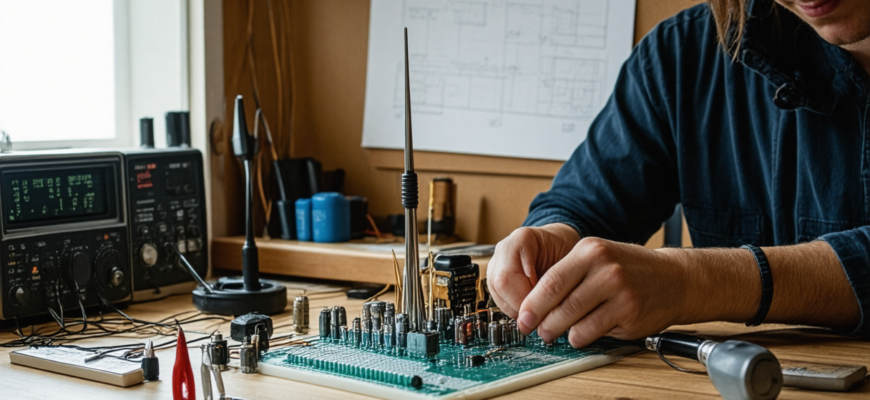
For amateur radio operators, efficient transmission and reception depend heavily on the proper matching of the transmitter’s output impedance to the antenna’s impedance. An antenna tuner, also known as an impedance matching device, can significantly improve signal strength, clarity, and overall communication quality. While commercial antenna tuners are widely available, they often come at a high cost and may contain features that are unnecessary for hobbyist needs. Fortunately, with basic electronic components and a bit of ingenuity, it is possible to build a simple, low-cost antenna tuner at home. This guide provides detailed instructions, useful formulas, and practical tips for constructing an effective device tailored for amateur radio enthusiasts.
- Understanding the Basics of Antenna Tuning
- What Is an Antenna Tuner?
- The Importance of Impedance Matching
- Principles of Simple Antenna Tuner Design
- Key Components
- Basic Tuner Configurations
- Materials and Tools Needed
- Step-by-Step Construction Process
- Step 1: Design Your Tuner
- Step 2: Winding the Inductor
- Step 3: Installing the Variable Capacitor
- Step 4: Assembling the Circuit
- Step 5: Enclosure and Final Assembly
- Testing and Tuning Procedures
- Initial Testing
- Adjusting the Tuner
- Optimizing Performance
- Practical Tips and Troubleshooting
- Advantages of a Homemade Antenna Tuner
- Limitations and Precautions
- Summary and Final Thoughts
Understanding the Basics of Antenna Tuning
What Is an Antenna Tuner?
An antenna tuner, or antenna matching unit (AMU), is a device that matches the impedance of the transmitter to that of the antenna system. Ideally, radio transmitters are designed to operate at a standard impedance of 50 ohms. However, the impedance of antennas can vary widely depending on their length, height, surrounding environment, and frequency used. An effective antenna tuner adjusts the impedance seen by the transmitter, ensuring maximum power transfer and reducing signal reflection.
The Importance of Impedance Matching
Correct impedance matching minimizes Standing Wave Ratio (SWR), which is a measure of how well the load (antenna) is matched to the transmission line. High SWR values indicate poor matching, leading to reflected power, decreased transmitted power, and potential damage to the transmitter. A well-built, low-cost home antenna tuner helps keep SWR within safe limits, often below a value of 2:1.
Principles of Simple Antenna Tuner Design
Key Components
- Variable Capacitor: Adjusts the reactance to achieve resonance.
- Inductance (Inductor): Works with the capacitor to match the impedance.
- Transformer or Balun (optional): Facilitates impedance transformation and balanced-to-unbalanced transition.
- Connection Terminals: For attaching the transmitter, feedline, and antenna.
Basic Tuner Configurations
- L-Network: Simplest configuration with a series inductor and shunt capacitor or vice versa.
- Pi-network: Utilizes two capacitors and one inductor for broader tuning range.
- Reverse-tee/T-network: Common for simple home-built tuners, offering easy adjustments.
Materials and Tools Needed
| Material / Part | Description / Specifications |
|---|---|
| Variable Capacitor | 10-50 pF or 50-150 pF, depending on frequency range |
| Inductor | Adjustable or fixed, 10-200 µH (microhenries) |
| Coaxial Cables | RG-58 or similar, for connections |
| Connectors | SMA, BNC, or PL-259, depending on equipment compatibility |
| Chassis or Enclosure | Plastic or metal box to house components |
| Variable Resistor or Potentiometer | For fine-tuning, optional |
| Tools | Soldering iron, wire cutters, screwdrivers, multimeter, coil winding tool |
Step-by-Step Construction Process
Step 1: Design Your Tuner
Decide on the type of antenna tuner. For simplicity and affordability, a basic L-network with a variable capacitor and inductor is recommended. Determine the typical frequency range you intend to operate on (e.g., 80m, 40m bands). Use this information to select components that can handle the voltage and power levels, usually up to 100 W for hobbyist applications.
Step 2: Winding the Inductor
- Choose a ferrite or air-core coil former.
- Calculate the number of turns based on the desired inductance using the formula:
L = (μ₀ * μ_r * N² * A) / lwhere:
- L = inductance in Henrys
- μ₀ = permeability of free space (~4π × 10⁻⁷ H/m)
- μ_r = relative permeability (for air-core, ≈1)
- N = number of turns
- A = cross-sectional area of coil (m²)
- l = length of the coil (m)
- Wind the wire evenly, ensuring tight and uniform turns.
- Secure the coil with adhesive or tape, leaving leads for connection.
Step 3: Installing the Variable Capacitor
Mount the variable capacitor securely on the chassis. Connect one terminal to the inductor and the other to the output terminal. For a simple series or parallel LC circuit, configuration depends on the design chosen.
Step 4: Assembling the Circuit
Connect the inductor and capacitor according to the chosen configuration. Use insulated wiring to avoid shorts. Add a removable test port or connector to connect the transmitter and antenna feedline.
Step 5: Enclosure and Final Assembly
Place all components within a protective enclosure. Ensure proper ventilation if components are power-hungry. Add labels for each control and connection point for easy operation during tuning.
Testing and Tuning Procedures
Initial Testing
Verify all connections with a multimeter. Ensure there are no shorts or open circuits. Connect a dummy load or actual antenna system, depending on setup.
Adjusting the Tuner
- Power on the transmitter and set it to a low power level to avoid damage during initial tests.
- Connect the antenna feedline to the tuner and transmitter.
- Gradually adjust the variable capacitor and inductor to minimize SWR, measured with an SWR meter.
- Record the settings for future reference.
Optimizing Performance
Fine-tune the components while maintaining a steady transmitter power. When SWR drops below 2:1, the tuner is optimally adjusted. Repeat these steps for different frequencies within your operating range to achieve broad-band matching if necessary.
Practical Tips and Troubleshooting
- Component Quality: Use high-quality variable capacitors with low leakage and stable capacitance.
- Component Ratings: Ensure inductors and capacitors can handle peak voltages and power levels during operation.
- Connectivity: Use firm, soldered connections to prevent accidental disconnects or impedance variations.
- Thermal Management: Place components away from heat sources; consider adding a small fan for power-intensive components.
- Testing: Regularly verify SWR with an antenna analyzer or SWR meter, especially after adjusting components.
Advantages of a Homemade Antenna Tuner
- Cost-effective, often costing below $50 in parts.
- Customizable for specific bands and power levels.
- Educational experience and increased understanding of radio electronics.
- Portability due to compact design.
- Ability to modify and improve over time based on operating needs.
Limitations and Precautions
While a simple homemade tuner is suitable for many amateur radio applications, it may not match the performance of commercial units optimized for wide frequency ranges or high power. Always respect component ratings to prevent damage or safety hazards. Proper grounding, shielding, and insulation are essential during construction and operation.
Summary and Final Thoughts
Building a low-cost, simple antenna tuner at home is an accessible and rewarding project for amateur radio operators. It offers an excellent opportunity to deepen understanding of impedance matching principles and electronic circuits. By carefully selecting components, following systematic assembly steps, and performing thorough testing, enthusiasts can create a reliable device suitable for enhancing their radio communication setup. Such a DIY approach not only saves money but also fosters a sense of accomplishment and technical proficiency essential for long-term hobby engagement. With patience and attention to detail, a homemade antenna tuner becomes a vital tool in the arsenal of any dedicated amateur radio operator.
Похожие записи:
 How to Build Your Own Homemade QRP Transceiver: A Comprehensive Guide for Amateur Radio Enthusiasts
  Building a Portable Ham Radio Station for Outdoor Expeditions: The Ultimate Guide
  Mastering Regulatory Changes: A Comprehensive Guide for Amateur Radio Enthusiasts
  Integrating Software-Defined Radio into Your Daily Operations: A Comprehensive Guide for Amateur Radio Enthusiasts
  Effective Troubleshooting Guide for Common Radio Hardware Issues in Amateur Radio
  Developing Effective Emergency Preparedness Plans with Ham Radio: A Comprehensive Guide for Amateur Radio Enthusiasts
  Innovative Antenna Designs for Enhanced HF Performance
  Comprehensive Review of the Latest Transceiver Models on the Market: Innovations and Performance for Amateur Radio Enthusiasts
  Build Your Own Portable Solar Power Setup for Radio Operations: A Comprehensive Guide
  Latest Developments in Spectrum Licensing and Frequency Allocations: A Comprehensive Overview for Amateur Radio Enthusiasts
  Effective Tips for Organizing Successful Ham Radio Contests: A Comprehensive Guide
  Integrating Internet-Linked Repeater Systems with Traditional Ham Gear: A Comprehensive Guide
  Ultimate Guide: Best Practices for Setting Up a Remote Radio Station Accessible Worldwide
  Advances in Battery Technology for Portable Ham Radio Use: Powering the Future of Amateur Radio
  New Regulations Affecting Amateur Radio Licensing and Operation: What You Need to Know
  Unlocking the Power of Connection: The Benefits of Joining Amateur Radio Contesting Communities