
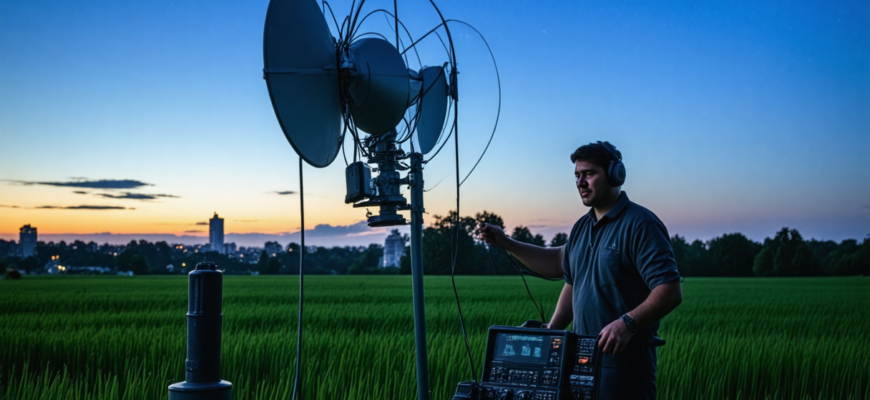
In the realm of amateur radio, one of the most critical factors influencing successful long-distance communication is the quality and design of the antenna. Among various types and configurations, high-gain antennas stand out for their ability to significantly extend communication range, improve signal quality, and facilitate more reliable contacts across vast distances. This comprehensive guide delves into the principles of high-gain antennas, their types, design considerations, and how hobbyists can optimize their setups for optimal performance.
- Understanding Antenna Gain and Its Importance
- What Is Antenna Gain?
- The Significance of High-Gain Antennas in Amateur Radio
- Types of High-Gain Antennas Used in Amateur Radio
- Directional Antennas
- Yagi-Uda Antennas
- Log-Periodic Dipole Arrays (LPDA)
- Parabolic Dish Antennas
- Omnidirectional High-Gain Antennas
- Design Principles of High-Gain Antennas
- Key Parameters Influencing Design
- Formula for Antenna Gain
- Building and Installing High-Gain Antennas
- Design Considerations
- Example: Building a Yagi-Uda Antenna
- Considerations for Maximizing Long-Distance Communication
- Propagation Conditions and Antenna Performance
- Optimizing Antenna Orientation and Tuning
- Practical Tips and Best Practices
- Regular Maintenance and Testing
- Choosing the Right Equipment
- Safety Considerations
- Enhancing Long-Distance Communication with High-Gain Antennas
- Summary Table: Key Points About High-Gain Antennas
- References and Further Reading
Understanding Antenna Gain and Its Importance
What Is Antenna Gain?
Antenna gain is a measure of how well an antenna directs radio frequency energy in a specific direction compared to a reference antenna, usually an isotropic radiator (a theoretical point source). It is expressed in units of decibels (dB). Higher gain indicates a stronger, more concentrated signal in a particular direction, which effectively extends the communication range and improves signal clarity.
The Significance of High-Gain Antennas in Amateur Radio
- Extended Range: High-gain antennas focus signals directionally, making long-distance contacts more feasible.
- Better Signal-to-Noise Ratio: Concentrated signals outperform omnidirectional ones, reducing interference and noise.
- Enhanced Reliability: Stronger, more focused signals improve the stability of connections.
Types of High-Gain Antennas Used in Amateur Radio
Directional Antennas
Directional antennas are designed to focus radio waves in a specific direction, thereby increasing gain in that direction. They are essential for long-distance communication because they maximize signal strength where it is most needed.
Yagi-Uda Antennas
The Yagi antenna is the most popular high-gain directional antenna used by amateurs. It consists of one driven element (dipole), multiple parasitic elements (reflectors and directors), all arranged linearly. The Yagi provides high gain with relatively simple construction, making it accessible for hobbyists.
Log-Periodic Dipole Arrays (LPDA)
LPDAs offer wide bandwidth and high gain, suitable for multi-band operation. Their design includes multiple dipoles of varying lengths arranged periodically, allowing effective performance across a broad frequency spectrum.
Parabolic Dish Antennas
Parabolic dishes provide exceptionally high gain but require precise alignment and are more complex to build and mount. They are more common in specialized long-distance or satellite communications but are used by some enthusiasts.
Omnidirectional High-Gain Antennas
While less common for long-distance work, some omnidirectional antennas can achieve high gain with proper design, extending coverage in all directions, which is useful in certain contesting and emergency scenarios.
Design Principles of High-Gain Antennas
Key Parameters Influencing Design
| Parameter | Description |
|---|---|
| Gain (dB) | Describes the focusing power of the antenna; higher gain indicates more focused signal. |
| Beamwidth | The angle over which the antenna radiates most of its energy; narrower beamwidth correlates with higher gain. |
| Front-to-Back Ratio | The ratio of power radiated forward compared to backward; important for minimizing interference. |
| VSWR | Voltage Standing Wave Ratio; indicates how well the antenna is matched to the feedline, affecting efficiency. |
Formula for Antenna Gain
The gain (G) of a directional antenna can be approximated using the following formula:
G (dBi) = 10 * log10 (Efficiency * Directivity)
where:
- Efficiency accounts for real-world losses (typically 0.8-1.0).
- Directivity measures the concentration of radiated power in a specific direction, typically calculated based on beamwidth and wavelength.
Building and Installing High-Gain Antennas
Design Considerations
When constructing high-gain antennas, hobbyists must consider several factors to ensure optimal performance and durability:
- Frequency Band: Select the antenna design compatible with the desired operating bands (e.g., 80m, 40m, 2m).
- Size and Materials: Larger elements yield higher gain but require more space; use durable materials resistant to weather.
- Mounting and Orientation: Ensure stable mounting on a tower or mast, with a rotator for directional aiming.
- Impedance Matching: Properly match the antenna to the feedline (usually 50Ω) to minimize power loss.
Example: Building a Yagi-Uda Antenna
Constructing a Yagi involves:
- Calculating element lengths based on the operating frequency:
Element Length (meters): (L = frac{71.5}{f_{GHz}})
- The driven element length is typically about half the wavelength.
- Reflector element is slightly longer, and directors are slightly shorter than the driven element.
Assembling these components with supportive booms and ensuring proper spacing (generally 0.2–0.4 wavelengths) maximizes gain.
Considerations for Maximizing Long-Distance Communication
Propagation Conditions and Antenna Performance
Effective long-distance communication depends on understanding radio wave propagation phenomena such as skywave, tropospheric ducting, and ionospheric layers. High-gain antennas maximize signal directionality during these phenomena, but operators must also consider:
- Time of Day: Ionospheric conditions vary, affecting signalreachability.
- Frequency Selection: Operating at optimal frequencies for the time and propagation mode.
- Polarization: Matching the antenna polarization with the transmitting station enhances signal quality.
Optimizing Antenna Orientation and Tuning
- Use a rotator to precisely aim directional antennas toward intended contacts.
- Regularly inspect and retune antenna elements to maintain resonance and impedance matching.
- Monitor VSWR readings to ensure efficient power transfer and prevent damage.
Practical Tips and Best Practices
Regular Maintenance and Testing
Maintaining the performance of high-gain antennas involves periodic inspection of elements, connectors, and mounting hardware. Use an SWR meter to verify tuning and make adjustments as needed. Weatherproof all components to prevent corrosion and mechanical stress.
Choosing the Right Equipment
- RF Feedline: Use quality cable (e.g., RG-213, LMR-400) for low loss.
- Rotators: Invest in reliable rotator systems for precise aiming and durability.
- Supports and Mounts: Use sturdy masts and guy wires to withstand wind loads.
Safety Considerations
High-gain antennas and tall masts pose electrical safety hazards. Always ensure proper grounding, avoid contact with power lines, and adhere to local safety regulations during installation and maintenance.
Enhancing Long-Distance Communication with High-Gain Antennas
For amateur radio enthusiasts seeking to push the boundaries of their communication capabilities, high-gain antennas are invaluable tools. By understanding the principles of antenna gain, selecting the appropriate antenna type, and meticulously designing and aligning the setup, any operator can significantly extend their reach. While building and maintaining high-gain antennas requires effort and attention to detail, the rewards include more contacts, clearer signals, and the thrill of bridging distant locations across the globe. Mastery of these antennas is an essential step toward becoming a proficient long-distance communicator in the vibrant world of amateur radio.
Summary Table: Key Points About High-Gain Antennas
| Aspect | Detail |
|---|---|
| Gain Range | Typically 6 dB to 20+ dB, depending on design and size |
| Common Types | Yagi, Log-Periodic, Parabolic Dish, Helical |
| Best Usage | Long-distance point-to-point communication, contesting, DXing |
| Design Focus | Maximize directivity, minimize losses, ensure stability |
References and Further Reading
- Ulrich, C. (2012). Antenna Theory: Analysis and Design. Wiley.
- BA5BD Ham Radio Blog. “Practical Yagi Design”.
- ARRL Antenna Book, 23rd Edition. American Radio Relay League.
Похожие записи:
 Unlocking the Power of Connection: The Benefits of Joining Amateur Radio Contesting Communities
  Top Choices for Budget-Friendly Amateur Radio Equipment: A Comprehensive Guide for Hobbyists
  Mastering DXing: Expert Tips for Contacting Rare Amateur Radio Stations
  Building a Simple, Low-Cost Antenna Tuner at Home: A Comprehensive Guide for Amateur Radio Enthusiasts
  Emergency Communication Protocols for Ham Radio Operators: The Latest Updates and Best Practices
  How to Build Your Own Homemade QRP Transceiver: A Comprehensive Guide for Amateur Radio Enthusiasts
  Integrating Software-Defined Radio into Your Daily Operations: A Comprehensive Guide for Amateur Radio Enthusiasts
  Innovative Antenna Designs for Enhanced HF Performance
  Effective Troubleshooting Guide for Common Radio Hardware Issues in Amateur Radio
  Comprehensive Review of the Latest Transceiver Models on the Market: Innovations and Performance for Amateur Radio Enthusiasts
  Top 10 Portable Ham Radios for On-the-Go Enthusiasts
  Latest Developments in Spectrum Licensing and Frequency Allocations: A Comprehensive Overview for Amateur Radio Enthusiasts
  Building a Portable Ham Radio Station for Outdoor Expeditions: The Ultimate Guide
  Mastering Regulatory Changes: A Comprehensive Guide for Amateur Radio Enthusiasts
  Advances in Battery Technology for Portable Ham Radio Use: Powering the Future of Amateur Radio
  Ultimate Guide: Best Practices for Maintaining and Extending the Lifespan of Your Radio Equipment