
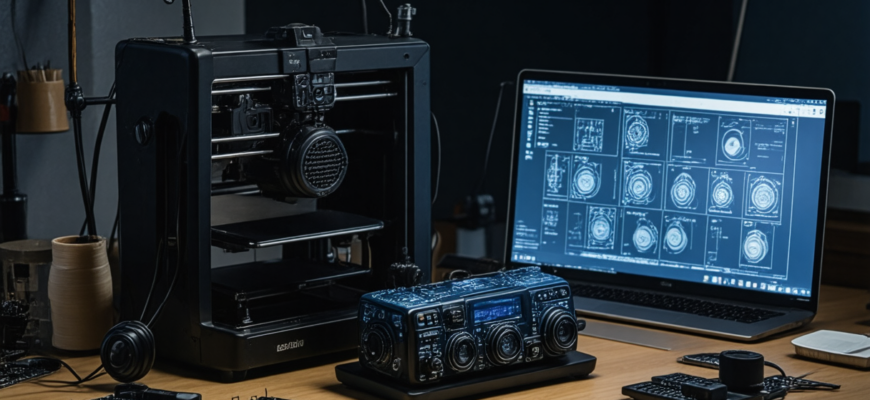
The landscape of amateur radio has experienced a transformative shift in recent years, driven by technological advancements and the democratization of manufacturing tools. Among the most impactful innovations is 3D printing, which offers hobbyists and professionals alike the ability to craft custom radio components with unprecedented precision, cost-effectiveness, and flexibility. This extensive review delves into various 3D printing solutions suited for creating bespoke parts for amateur radio equipment, exploring their features, applications, advantages, and limitations to help enthusiasts optimize their projects and push the boundaries of radio experimentation.
- What is 3D Printing and Its Relevance to Amateur Radio?
- Understanding 3D Printing
- Why is 3D Printing Relevant to Amateur Radio?
- Types of 3D Printing Technologies Suitable for Radio Parts
- Fused Deposition Modeling (FDM)
- Stereolithography (SLA) and Digital Light Processing (DLP)
- Selective Laser Sintering (SLS)
- Key Considerations When Choosing a 3D Printer for Radio Parts
- Material Compatibility and Mechanical Properties
- Resolution and Surface Finish
- Build Volume
- Cost and Accessibility
- Post-Processing Requirements
- Popular 3D Printing Solutions for Custom Radio Components
- FDM 3D Printers: The Workhorse of Radio Hobbyists
- Use Cases in Amateur Radio
- SLA/DLP Resin Printers: For Precision and Detailing
- Application Highlights
- SLS and Industrial Solutions: For Durability and Complex Designs
- Practical Applications: Enhancing Amateur Radio Projects with 3D Printing
- Creating Custom Enclosures and Cases
- Designing and Manufacturing Antenna Parts
- Developing Accessories and Aids
- Prototyping and Testing New Designs
- Advantages of Using 3D Printing in Amateur Radio
- Limitations and Challenges of 3D Printing for Radio Parts
- Future Trends and Innovations in 3D Printing for Amateur Radio
- Emerging Materials
- Multi-Material Printing
- Integration of Electronics
- Community-Driven Innovation
- Embracing 3D Printing for Better Radio Projects
- References and Resources
What is 3D Printing and Its Relevance to Amateur Radio?
Understanding 3D Printing
3D printing, also known as additive manufacturing, is a process involving the layer-by-layer construction of three-dimensional objects based on digital models. Unlike traditional subtractive manufacturing, which involves carving away material, 3D printing deposits material precisely where needed, enabling rapid prototyping, customization, and complex geometries that are otherwise challenging to produce.
Why is 3D Printing Relevant to Amateur Radio?
Amateur radio operators often require specialized, unique, or modified parts to improve functionality, aesthetics, or durability of their stations. Traditionally, such custom components demanded outsourcing machining or fabrication, leading to cost and time constraints. 3D printing offers a practical solution for hobbyists, enabling the quick production of custom enclosures, antenna parts, mounting brackets, knobs, buttons, and even entire chassis tailored to specific needs.
Types of 3D Printing Technologies Suitable for Radio Parts
Fused Deposition Modeling (FDM)
FDM is the most common and accessible 3D printing technology, utilizing thermoplastic filaments such as PLA, ABS, PETG, and TPU. The filament is melted and extruded through a nozzle layer by layer to build the object.
- Advantages: Cost-effective, widely available, easy to operate, suitable for larger parts.
- Limitations: Lower resolution surface finish, anisotropic strength, and potential warping with certain materials.
Stereolithography (SLA) and Digital Light Processing (DLP)
These resin-based technologies use light to cure liquid photopolymer resins with high precision. They produce parts with smooth surfaces, fine details, and complex geometries.
- Advantages: High-resolution prints, excellent surface finish, ideal for small or detailed components.
- Limitations: Higher costs, resin handling requirements, and limited material options.
Selective Laser Sintering (SLS)
SLS employs a laser to sinter powdered materials like nylon into solid objects. It facilitates the manufacturing of durable, functional parts with complex structures without support material.
- Advantages: Strong, resilient parts, complex geometries, minimal post-processing.
- Limitations: Expensive machines, higher operational costs, and specialized handling.
Key Considerations When Choosing a 3D Printer for Radio Parts
Material Compatibility and Mechanical Properties
Radio components often face environmental stress, mechanical strain, and electrical interference. Selecting appropriate materials—such as ABS for durability or PETG for chemical resistance—is vital for functional parts.
Resolution and Surface Finish
High-resolution printers like SLA or DLP are preferable for intricate parts needing fine detail and smooth finish, whereas FDM printers are suitable for larger, less detailed components with rougher surfaces.
Build Volume
Consider the maximum size of parts you intend to produce. Larger enclosures or antenna mounts may require printers with a substantial build chamber.
Cost and Accessibility
Budget constraints influence the choice of printer. FDM printers are typically more affordable, while resin-based systems and SLS machines are higher cost but offer superior precision.
Post-Processing Requirements
Some technologies require extensive post-processing—such as sanding, curing, or support removal—which may impact workflow and project timelines.
Popular 3D Printing Solutions for Custom Radio Components
FDM 3D Printers: The Workhorse of Radio Hobbyists
FDM printers like Prusa i3 MK3S+, Creality Ender 3 V2, and FlashForge Finder are widely favored for their affordability and ease of use. They allow hobbyists to produce a wide array of parts, from custom enclosures to antenna mounts, with reasonable precision.
Use Cases in Amateur Radio
- Custom case and enclosure fabrication for radio transmitters and receivers
- Mounts and brackets for antennas and accessories
- Knobs, switches, and button caps
- Cooling fans and ventilation ducts
SLA/DLP Resin Printers: For Precision and Detailing
Devices like Formlabs Form 3 or Anycubic Photon Mono provide high-detail prints ideal for small but intricate components such as custom connectors, labeling, or decorative elements.
Application Highlights
- Printable labels or overlays for panels
- Small parts like connectors or switches with fine details
- Decorative elements for aesthetic customization
SLS and Industrial Solutions: For Durability and Complex Designs
While less accessible for most amateurs due to cost and complexity, small-scale SLS services or printers such as Sinterit Lisa can produce durable, complex parts like rugged enclosures or high-strength antenna components.
Practical Applications: Enhancing Amateur Radio Projects with 3D Printing
Creating Custom Enclosures and Cases
Enclosures protect sensitive electronics from dust, moisture, and mechanical impact. Using 3D printing, operators can design enclosures tailored to their specific equipment layout, ensuring optimal size and cooling features.
Designing and Manufacturing Antenna Parts
Custom antenna elements, mounts, and radomes can be fabricated to optimize performance or aesthetics. Lightweight and robust 3D printed parts allow for quick modifications and testing of different designs.
Developing Accessories and Aids
Knobs, switches, labels, connectors, and other accessories can be personalized, improving user interface and station ergonomics. Replacement parts or upgrades are easily produced, reducing dependency on commercial suppliers.
Prototyping and Testing New Designs
Rapid prototyping reduces the time from concept to implementation, enabling experimentation with novel configurations, mechanisms, and aesthetics before committing to permanent solutions.
Advantages of Using 3D Printing in Amateur Radio
| Benefit | Description |
|---|---|
| Customization | Design unique parts tailored precisely to individual needs without relying on off-the-shelf solutions. |
| Cost-Effectiveness | Reduce costs for small batches or one-off parts by avoiding mass production setup expenses. |
| Rapid Prototyping | Quickly iterate and improve designs, accelerating development cycles. |
| Accessibility | Availability of desktop 3D printers allows hobbyists to produce parts at home or small workshops. |
| Innovation | Open opportunities for experimenting with new geometries, materials, and functionalities. |
Limitations and Challenges of 3D Printing for Radio Parts
- Material Limitations: Not all materials offer the electrical conductivity, heat resistance, or mechanical properties necessary for specific radio components.
- Surface Finish and Tolerances: FDM parts tend to have rough surfaces and dimensional inaccuracies, which may require post-processing.
- Structural Integrity: Some 3D printed parts may lack the strength needed for high-stress applications unless reinforced.
- Fillament and Resin Costs: Ongoing expenses can add up, especially for higher-quality materials or resins.
- Design Skills and Post-Processing: Producing effective parts requires design expertise and time investments in finishing touches.
Future Trends and Innovations in 3D Printing for Amateur Radio
Emerging Materials
Developments include conductive filaments, heat-resistant composites, and flexible resins, broadening the range of functional parts possible with 3D printing.
Multi-Material Printing
Advances in multi-material printers will enable the creation of complex parts combining rigid, flexible, and conductive functionalities within a single print.
Integration of Electronics
Embedding electronic components directly into 3D printed parts, such as circuits or antennas, can streamline assembly and enhance performance.
Community-Driven Innovation
The amateur radio community continues to share open-source designs, fostering collaborative improvements and customization of 3D printable parts for various applications.
Embracing 3D Printing for Better Radio Projects
3D printing has revolutionized the way amateur radio enthusiasts approach project development and customization. From simple enclosures to complex antenna designs, the technology provides an accessible, flexible, and cost-effective means to innovate and improve station capabilities. While limitations exist, ongoing advancements and the evolving landscape of materials and machinery promise even greater potential for hobbyists eager to push the boundaries of their radio experiments. By understanding the specific advantages and constraints of different 3D printing solutions, operators can select the best approach to enhance their station’s performance and aesthetics, ultimately enabling more creative, durable, and efficient amateur radio setups.
References and Resources
- RepRap Project: Open-source 3D printer community and resources.
- Formlabs: SLA 3D printing solutions and resin information.
- Sinterit: Compact SLS 3D printers and materials.
- Thingiverse: Community platform for sharing 3D printable designs, including radio-related projects.
- Using 3D Printing for Amateur Radio Projects: Article on practical applications and tips.
As technology continues to evolve, the synergy between 3D printing and amateur radio is set to grow even stronger, empowering enthusiasts to innovate and customize their stations like never before.
Похожие записи:
 Comprehensive Review of Radio Programming Software for Beginners
  Comprehensive Review of the Latest Transceiver Models on the Market: Innovations and Performance for Amateur Radio Enthusiasts
  Building a Simple, Low-Cost Antenna Tuner at Home: A Comprehensive Guide for Amateur Radio Enthusiasts
  Top Choices for Budget-Friendly Amateur Radio Equipment: A Comprehensive Guide for Hobbyists
  Integrating Software-Defined Radio into Your Daily Operations: A Comprehensive Guide for Amateur Radio Enthusiasts
  How to Build Your Own Homemade QRP Transceiver: A Comprehensive Guide for Amateur Radio Enthusiasts
  Build Your Own Portable Solar Power Setup for Radio Operations: A Comprehensive Guide
  Portable Antenna Analyzers for Precise Tuning: The Ultimate Guide for Amateur Radio Enthusiasts
  High-Gain Antennas for Long-Distance Communication: Unlocking Extended Reach in Amateur Radio
  Innovative Antenna Designs for Enhanced HF Performance
  Wireless Hotspot and Networking Devices for Remote Stations: Enhancing Connectivity for Amateur Radio Enthusiasts
  Latest Developments in Spectrum Licensing and Frequency Allocations: A Comprehensive Overview for Amateur Radio Enthusiasts
  Mastering Regulatory Changes: A Comprehensive Guide for Amateur Radio Enthusiasts
  Developing Effective Emergency Preparedness Plans with Ham Radio: A Comprehensive Guide for Amateur Radio Enthusiasts
  Top Accessories to Maximize Your Performance in Digital Mode Amateur Radio Operations
  Top Microphone and Speaker Combos for Clear Audio: The Ultimate Guide for Amateur Radio Enthusiasts